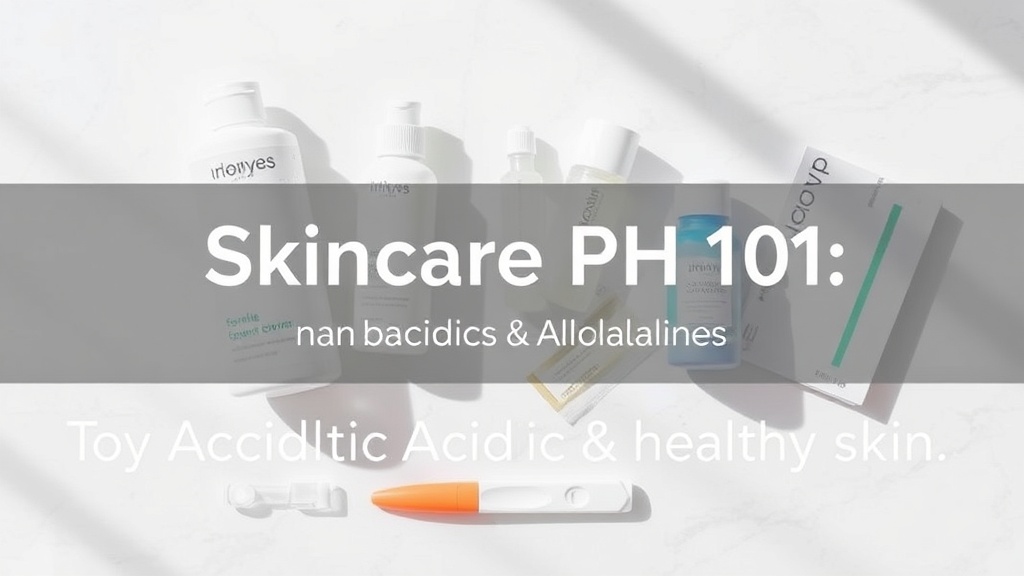
Skincare pH 101: How to Test and Balance Your Routine for Healthy Skin

Ever wonder why that gentle cleanser leaves your skin feeling tight while a serum makes it glow? The secret often lies in pH — the acidity or alkalinity of the product and your skin.
As a former pharmaceutical researcher turned skincare educator, I’ve spent years measuring pH in labs. Today I’m handing you the same tools so you can decode the chemistry behind every bottle on your shelf.
Why Does pH Matter for Your Skin?
Your skin’s natural “acid mantle” sits at a pH of roughly 4.5–5.5. This slightly acidic environment protects against harmful microbes, supports barrier lipids, and keeps enzymes that shed dead cells working smoothly. When you slap on a product that’s too alkaline (pH > 7), you strip that mantle, leading to dryness, irritation, and even breakouts.
What pH Range Is Ideal for Different Product Types?
Here’s a quick cheat‑sheet from the science:
- Cleansers & Toners: 4.0–5.5 – keep the acid mantle intact while removing grime.
- Serums (AHA/BHA, Vitamin C): 3.0–4.0 – the low pH helps acids penetrate for exfoliation or antioxidant stability.
- Moisturizers & Creams: 5.5–7.0 – a neutral to slightly alkaline base locks in hydration without upsetting the barrier.
- Sunscreens (physical): 6.0–7.5 – most mineral filters are stable in this range.
How Can I Test My Skincare Products at Home?
All you need is a cheap pH test strip set (often sold in packs of 100). Follow these steps:
- 1. Prep a small sample: Place a pea‑sized amount of product in a clean glass bowl. Add a drop of distilled water to dissolve if it’s thick (e.g., creams).
- 2. Dip the strip: Submerge the pH strip for 1–2 seconds. Avoid touching the strip to the container walls.
- 3. Read the color: Compare the strip’s hue to the chart on the strip package. Most kits give a 0‑14 scale.
- 4. Record your result: Keep a simple spreadsheet (Product | pH | Notes) so you can spot patterns over time.
Tip: Test products at room temperature. Extreme cold or heat can shift the reading by up to 0.5 pH points.
What If a Product’s pH Is Out of Range?
Don’t panic. You can often rescue a mis‑matched product:
- Too alkaline (pH > 7): Mix a few drops of a gentle lactic acid serum or a rinse‑off toner with a low pH to bring it down.
- Too acidic (pH < 3): Dilute with a neutral moisturizer before applying, or limit use to once a week.
- Severe mismatch: If irritation persists, consider swapping the product for a formula that aligns with its intended pH range.
How Do I Build a pH‑Balanced Routine?
Start with the foundation and layer upward, keeping the pH flow logical:
- Morning: Cleanse (pH 4.5) → Toner (pH 5.0) → Antioxidant serum (pH 3.5) → Moisturizer (pH 6.5) → Mineral sunscreen (pH 7).
- Evening: Cleanse → Exfoliating serum (AHA/BHA, pH 3.5) → Hydrating serum (pH 4.5) → Night cream (pH 6.5).
Notice how the acid‑based actives stay early in the sequence, while the more neutral moisturizers sit at the end to seal everything in.
Which of My Existing Products Might Need a pH Check?
Here are three common culprits that often sit outside the ideal range:
- Foaming cleansers: Many cheap foaming formulas are alkaline (pH 8–9) and can strip the barrier.
- Over‑the‑counter retinol creams: Some have a pH > 7 to stabilize the retinoid, which can cause irritation if layered over low‑pH serums.
- DIY “natural” masks: Lemon juice or vinegar‑based recipes can plunge the pH below 2, leading to burns.
If you recognize any of these in your cabinet, grab a strip and test. You might discover a simple fix that saves your skin.
Quick Decision Matrix: Should I Keep or Toss?
- pH 4–5.5 and no irritation: Keep — it’s skin‑friendly.
- pH > 7 with dryness/redness: Either reformulate (mix with low‑pH product) or replace.
- pH < 3 and stinging: Dilute or reserve for occasional use.
When in doubt, patch‑test a diluted sample for 48 hours before committing to full‑face use.
Takeaway: Your New Skincare Lab Routine
1️⃣ Grab a set of pH strips.
2️⃣ Test each product you use regularly.
3️⃣ Log the numbers and compare to the cheat‑sheet above.
4️⃣ Adjust formulas or swap products to stay within the ideal range.
5️⃣ Re‑test any new product before adding it to your routine.
Related Reading
- Bakuchiol vs Retinol: The 2026 Anti‑Aging Showdown — See how pH influences retinoid stability.
- How to Start Retinol Without Ruining Your Skin Barrier — A gentle entry point for low‑pH retinol.
- 5 Skincare Tips That Actually Work (And the Science Behind Them) — More evidence‑based hacks.
- The Best Sunscreens for Every Skin Type in 2026 — Choose a sunscreen with a skin‑friendly pH.