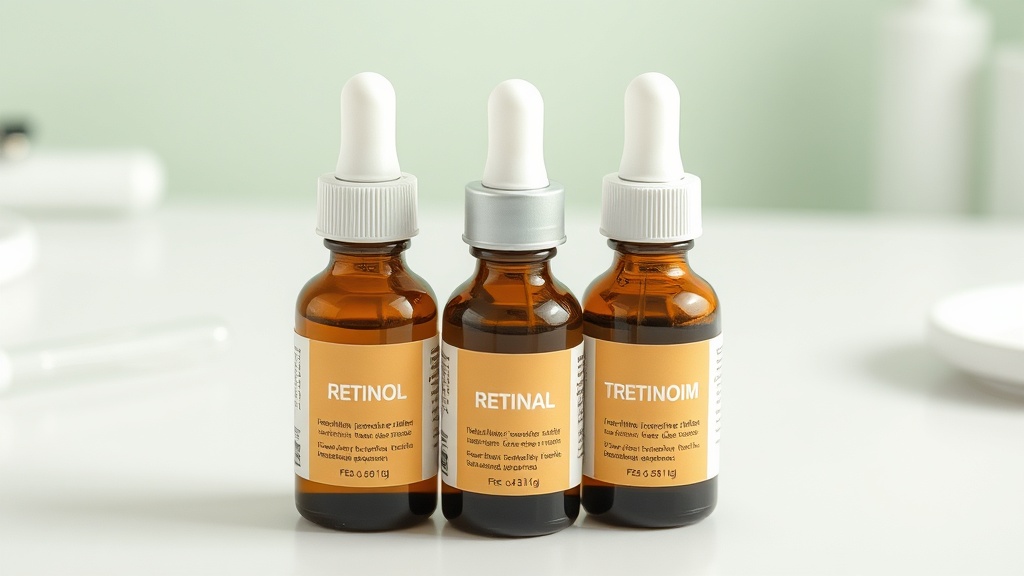
Retinol vs Retinal vs Tretinoin: The Actual Differences

Retinoids are the single most evidence-backed anti-aging ingredient in skincare. That's not an opinion — it's decades of clinical research.
But the retinoid family has members, and those members are not interchangeable. Retinol, retinal (retinaldehyde), and tretinoin are three different forms of vitamin A, and they behave very differently on your skin.
Here's the hierarchy and why it matters.
The Conversion Chain
All retinoids ultimately work by becoming retinoic acid — the active form that binds to skin cell receptors and produces results. The difference is how many conversion steps each form needs.
Retinol → Retinal → Retinoic Acid
- Retinol needs two enzymatic conversions to become retinoic acid
- Retinal (retinaldehyde) needs one conversion
- Tretinoin IS retinoic acid — no conversion needed
Each conversion step loses potency. Think of it like a game of telephone — every step between the original message and the final version introduces some loss.
This is why tretinoin produces faster, more dramatic results — but also why it causes more irritation. There's no buffer zone.
Retinol: The Gentle Entry Point
What it is: An over-the-counter form of vitamin A that your skin converts to retinal, then to retinoic acid.
Strengths:
- Widely available without a prescription
- Gentlest of the three — the two-step conversion means a slower, more controlled release of active retinoic acid
- Well-tolerated by most skin types
- Available in concentrations from 0.025% to 1%
Limitations:
- Slowest results (typically 12–24 weeks for visible improvement)
- Less potent at equivalent concentrations
- Unstable — degrades with light and air exposure (packaging matters)
Who it's for: Retinoid beginners, sensitive skin, anyone who wants anti-aging benefits without the adjustment period of stronger forms.
Evidence level: Strong. Multiple clinical trials demonstrate retinol's efficacy for fine lines, texture, and hyperpigmentation, though at a slower timeline than tretinoin.
Retinal (Retinaldehyde): The Middle Ground
What it is: One step closer to retinoic acid than retinol. Needs only one enzymatic conversion.
Strengths:
- Faster results than retinol (some studies show comparable efficacy to low-concentration tretinoin)
- Better tolerated than tretinoin — the single conversion step still provides some buffering
- Has additional antibacterial properties (unique among retinoids — relevant for acne)
- Over-the-counter availability
Limitations:
- Fewer products available (it's harder to formulate stably)
- More expensive per unit than retinol
- Can still cause irritation, particularly at higher concentrations
- Less long-term clinical data than retinol or tretinoin
Who it's for: People who've used retinol without issues and want stronger results without going to prescription tretinoin. Also excellent for acne-prone skin because of the antibacterial benefit.
Evidence level: Moderate to strong. A 2015 study in Dermatology and Therapy showed retinaldehyde 0.05% produced similar improvements to tretinoin 0.05% for photoaging, with significantly less irritation. More research would be welcome, but the existing data is encouraging.
Tretinoin: The Gold Standard
What it is: Prescription-strength retinoic acid. No conversion needed — it goes to work immediately.
Strengths:
- Most potent form
- Most extensively studied retinoid (50+ years of clinical research)
- Fastest visible results (typically 8–12 weeks)
- Proven efficacy for acne, photoaging, hyperpigmentation, and skin texture
- Only retinoid with strong evidence for actually increasing collagen production in the dermis
Limitations:
- Prescription only
- Significant adjustment period — the "retinoid uglies" (peeling, redness, dryness) are real and can last 4–8 weeks
- Not suitable for sensitive or reactive skin without careful titration
- Increases photosensitivity significantly — SPF is mandatory
Who it's for: Anyone serious about anti-aging or acne treatment who can tolerate the adjustment period. The evidence here is unmatched by any other skincare ingredient.
Evidence level: Very strong. Tretinoin has the most robust clinical evidence of any topical anti-aging ingredient. Period.
Practical Comparison
| Factor | Retinol | Retinal | Tretinoin |
|---|---|---|---|
| Conversion steps | 2 | 1 | 0 |
| Potency | Lowest | Middle | Highest |
| Irritation risk | Low | Moderate | High |
| Time to results | 12-24 weeks | 8-16 weeks | 8-12 weeks |
| Availability | OTC | OTC | Prescription |
| Stability | Unstable | Moderate | Stable |
| Evidence base | Strong | Moderate | Very strong |
How to Start
If you've never used a retinoid: Start with retinol at 0.3% or lower. Use it 2–3 nights per week. Build up frequency over 4–6 weeks. Always apply to dry skin after cleansing, follow with moisturizer.
If retinol feels too gentle: Move to retinaldehyde 0.05%. Same application rules — start slow, build up.
If you want maximum results: Talk to a dermatologist about tretinoin. Starting concentrations are typically 0.025% or 0.05%. The "sandwich method" (moisturizer, tretinoin, moisturizer) can reduce irritation during the adjustment period.
Universal rules for all retinoids:
- Apply at night (retinoids degrade in UV light)
- Use SPF every morning (non-negotiable)
- Don't combine with other strong actives (AHAs, BHAs, benzoyl peroxide) on the same night
- Moisturize generously — retinoids increase cell turnover and can compromise the barrier
Product Recommendations (28-Day Tested)
Budget
The Ordinary Retinol 0.5% in Squalane — ~$7
Simple, effective, incredibly affordable. The squalane base provides some moisture buffering. Start here if you're new to retinoids. Skip the 1% version until you've built tolerance.
CeraVe Resurfacing Retinol Serum — ~$22
Encapsulated retinol with niacinamide, ceramides, and licorice root. The encapsulation technology provides a slower release, reducing irritation. Excellent for sensitive skin beginners.
Mid-Range
Geek & Gorgeous A-Game 5 Retinal 0.05% — ~$16
One of the few affordable retinaldehyde products with a stable formulation. Contains bakuchiol as a complementary ingredient. Excellent texture, absorbs quickly. This is genuinely impressive for the price.
Paula's Choice Clinical 1% Retinol Treatment — ~$65
High concentration retinol in an elegant, stable formula with peptides and vitamin C. For experienced retinol users who aren't ready for prescription. The airless pump packaging maintains potency.
Splurge
SkinCeuticals Retinol 0.5 Refining Night Cream — ~$88
0.5% pure retinol in a formula designed to minimize irritation while maximizing delivery. Bisabolol and botanical extracts soothe the skin. Well-formulated but expensive for what is ultimately retinol.
The Bottom Line
Retinol, retinal, and tretinoin are not different products — they're different stops on the same metabolic pathway. Each has its place:
- Retinol for beginners and maintenance
- Retinal for the middle ground between OTC and prescription
- Tretinoin for maximum evidence-backed results
Don't start at the top. Work your way up. And whatever you choose — wear your sunscreen.
Medical disclaimer: I'm not a dermatologist. The information here is educational and not medical advice. Tretinoin requires a prescription — consult a healthcare provider.
— Priya Chakraborty
Former pharmaceutical researcher explaining skincare science in plain English.