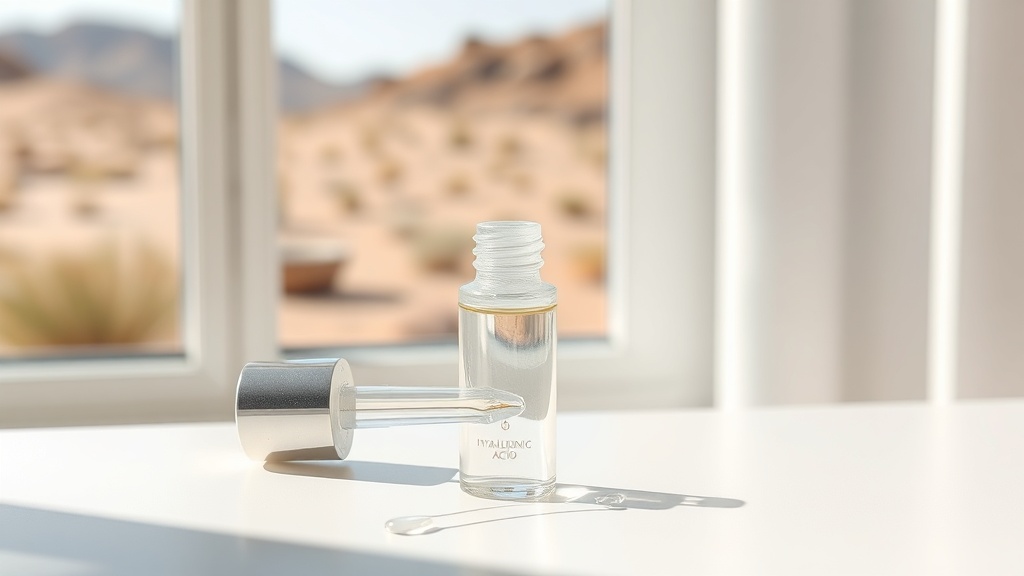
Hyaluronic Acid in Dry Climates: Why It Might Be Hurting Your Skin

People email me some version of this question almost every winter: "Priya, everyone says hyaluronic acid is the best ingredient for dry skin — so why does my face feel more dry after I use it?"
Short answer: hyaluronic acid (HA) is a humectant, meaning it pulls water toward itself. In humid environments that's great — it pulls moisture from the air into your skin. But in dry climates, it may pull water from deeper layers of your skin instead. That can leave your skin feeling tighter or drier if you don't use it correctly.
The ingredient itself isn't the problem. The way people use it is.
Let's break this down.
What Hyaluronic Acid Actually Does
Hyaluronic acid is a humectant — a class of ingredients that attract and hold water. Think of it like a tiny molecular sponge. One gram of hyaluronic acid can theoretically hold up to 1,000 times its weight in water.
That sounds impressive (and it is), but there's an important detail people miss:
Humectants don't create moisture. They move moisture.
Think of it like a magnet for water. Wherever the nearest water source is, HA pulls it closer. That source can be:
- Humidity in the air
- Water already on the surface of your skin
- Water deeper inside your skin
Which one it pulls from depends on the environment.
Why Dry Climates Change Everything
In a humid environment — think Miami in August — the air is full of water vapor. Hyaluronic acid happily pulls that moisture toward the skin.
But in low humidity environments (cold winters, desert climates, heavily air-conditioned rooms), there's very little water in the air. So where does the HA pull water from?
Your skin.
More specifically, from the dermis, the deeper layer where your skin stores moisture. If that water reaches the surface and evaporates before being sealed in, your skin can end up losing more water than it gained.
Dermatologists call this process transepidermal water loss (TEWL) — basically moisture escaping from the skin barrier.
That's why someone living in Colorado, Alberta, or Minnesota in winter can apply a hyaluronic acid serum and feel tighter skin afterward. The ingredient worked exactly as designed. It just didn't have the right water source.
Molecular Weight: Not All HA Is the Same
Here's where formulation chemistry gets interesting.
"Hyaluronic acid" on an ingredient list doesn't tell you the whole story. The molecule comes in different molecular weights, and those behave differently on skin.
Think of molecular weight like the size of the sponge.
High Molecular Weight HA
Large molecules that sit on the surface of the skin.
- Form a hydrating film
- Reduce water evaporation
- Provide immediate plumping
- Evidence level: Moderate
Low Molecular Weight HA
Smaller molecules that can move slightly deeper into the upper skin layers.
- Improve hydration within the stratum corneum
- Support elasticity
- Potentially stimulate skin repair signaling
- Evidence level: Moderate to preliminary
Very small fragments can sometimes increase inflammation in sensitive skin — which is why formulations matter.
Multi-Weight HA Formulas
Many modern serums combine several molecular weights. Large molecules hydrate the surface, smaller ones hydrate slightly deeper layers. When done well, this can create longer-lasting hydration. When done poorly, it's mostly marketing.
The Real Problem: How People Use HA
Most people apply hyaluronic acid incorrectly, which is why the ingredient gets blamed. The biggest mistakes I see:
- Applying it to completely dry skin
- Using it without a moisturizer
- Using it in very dry air with no occlusive layer
Remember: HA pulls water. If there's no water available, it'll pull from your skin.
How to Use Hyaluronic Acid Correctly
Step 1: Apply to Damp Skin
After cleansing, leave your skin slightly damp. You can also mist your face with water if needed. This gives hyaluronic acid an external water source to bind to.
Step 2: Apply the HA Serum
Use a small amount — usually 2–3 drops. Spread it evenly across the face.
Step 3: Seal It In With a Moisturizer
This step is the one people skip. Apply a moisturizer containing occlusive ingredients like petrolatum, dimethicone, ceramides, or squalane. Occlusives form a barrier that reduces water evaporation.
Step 4: Adjust for Climate
If you live in a very dry climate, consider using a humidifier, choosing thicker moisturizers, or applying HA only at night.
Skin Tone Considerations
Melanin-rich skin (Fitzpatrick IV–VI) tends to be more prone to transepidermal water loss, especially in cold or dry climates. When the barrier is compromised, irritation can trigger post-inflammatory hyperpigmentation. That means hydration routines matter even more.
Product Recommendations (28-Day Tested)
Budget
The Ordinary Hyaluronic Acid 2% + B5 — ~$9
Multiple molecular weights, includes panthenol for barrier support, minimal formula, no fragrance. One of the best value hydrating serums available.
CeraVe Hydrating Hyaluronic Acid Serum — ~$17
HA + ceramides + glycerin. Very barrier-friendly. Excellent for sensitive or dry skin.
Mid-Range
Paula's Choice Hyaluronic Acid Booster — ~$39
Multiple HA forms, added ceramides, elegant texture. Great formulation.
La Roche-Posay Hyalu B5 Serum — ~$40
HA + panthenol + madecassoside. Nice hydrating serum, though not dramatically different from cheaper options.
Splurge
SkinCeuticals Hydrating B5 Gel — ~$90
Minimal formula, excellent texture, reliable hydration. Very good — but not six times better than drugstore options.
The Bottom Line
Hyaluronic acid isn't bad for dry climates — it's just misunderstood.
Humectants pull water. If you don't give them water, they'll pull it from your skin.
Use HA correctly:
- Apply to damp skin
- Follow with a moisturizer
- Use occlusives in dry environments
Skincare is chemistry. And chemistry cares a lot about context.
That's the part the marketing usually forgets.
Medical disclaimer: I'm not a dermatologist. The information here is educational and not medical advice.
— Priya Chakraborty
Former pharmaceutical researcher explaining skincare science in plain English.