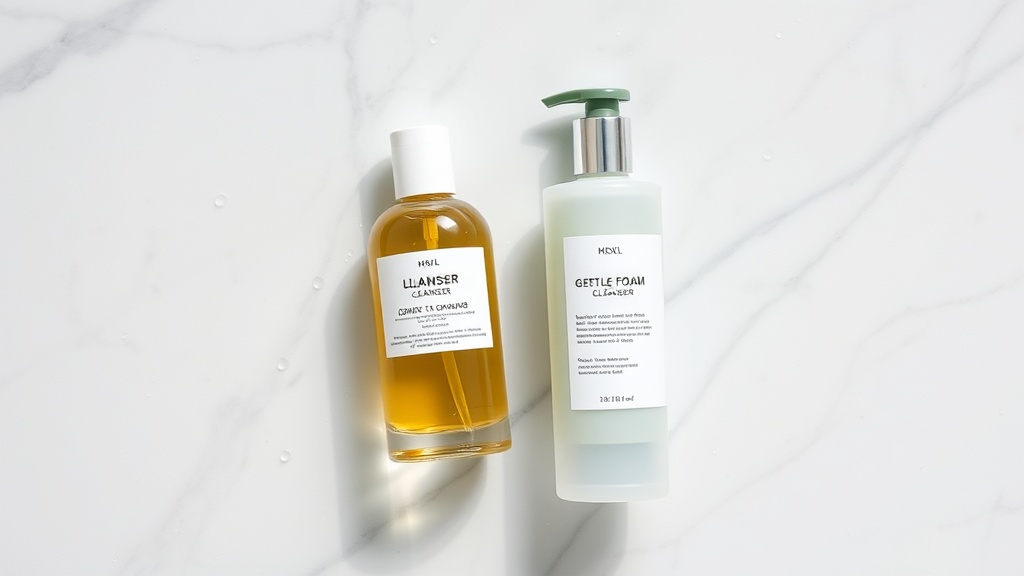
Double Cleansing: Do You Actually Need It?

Double cleansing is one of those skincare steps that inspires oddly passionate debate. Some people swear it transformed their skin. Others call it an unnecessary extra step invented to sell more products.
Both camps have a point — because whether you need double cleansing depends entirely on what you put on your face during the day.
Let me explain the chemistry, then you can decide for yourself.
What Double Cleansing Actually Is
Double cleansing means washing your face in two steps:
Step 1: Oil-based cleanser — an oil, balm, or micellar water that dissolves oil-soluble impurities (sunscreen, makeup, sebum, environmental pollutants that bind to skin oils).
Step 2: Water-based cleanser — a gentle gel, cream, or foam cleanser that handles water-soluble debris (sweat, dirt, remaining residue).
The concept comes from Korean and Japanese skincare traditions, where it's been standard practice for decades. It went mainstream in Western skincare around 2015.
The Chemistry: Why One Cleanser Sometimes Isn't Enough
This comes down to a basic principle of chemistry: like dissolves like.
Oil-based impurities dissolve best in oil. Water-based impurities dissolve best in water. Most single cleansers are water-based with surfactants — they're decent at removing water-soluble debris and some oil, but they're not optimized for dissolving heavy oil-based products.
Modern sunscreens are the best example. Many SPF formulas are designed to be water-resistant and film-forming — which is exactly what makes them effective. But that same resilience means a single water-based cleanser may not remove them completely.
A 2019 study in the International Journal of Cosmetic Science found that water-resistant sunscreens left measurable residue after a single cleanse with a standard foaming cleanser. A two-step process (oil cleanser followed by water cleanser) achieved significantly more complete removal.
Evidence level: Moderate. The chemistry is sound, though the clinical research specifically on double cleansing outcomes is limited.
When Double Cleansing Makes Sense
You wear SPF daily. If you're applying sunscreen every morning (and you should be), an oil cleanser in the PM ensures you're actually removing it. Sunscreen residue left on the skin overnight can contribute to clogged pores and dullness.
You wear makeup. Foundation, concealer, and setting powders are oil-based or wax-based products. An oil cleanser emulsifies these efficiently. You've probably noticed that regular cleansers can leave a faint ring of foundation along your jawline — that's incomplete removal.
You have oily skin. This sounds counterintuitive — why add oil to oily skin? But oil cleansers dissolve excess sebum without stripping the barrier. Your skin produces less compensatory oil when it's not being aggressively stripped. Many people with oily skin find their sebum production normalizes with double cleansing.
You live in a polluted environment. Particulate matter and urban pollutants bind to skin oils. An oil cleanser removes this layer more effectively than water-based cleansing alone.
When You Can Skip It
You don't wear SPF or makeup. If your skin has minimal product on it, a single gentle cleanser is sufficient. Don't add steps you don't need.
Your skin is very dry or sensitive. Double cleansing means more contact time with cleansing agents. If your barrier is already compromised, this additional step can worsen dryness or irritation. A single cream cleanser might be enough.
Morning cleanse. You don't need to double cleanse in the morning. Your skin hasn't accumulated sunscreen or makeup overnight. A gentle water-based cleanser (or even just water) is fine.
You use micellar water. Micellar water contains micelles — tiny oil molecules suspended in water. It already bridges the oil/water divide. If you cleanse thoroughly with micellar water first, your second cleanser is handling a much lighter load. Some people find micellar water alone is sufficient, though I'd still follow with a rinse-off cleanser to remove surfactant residue.
How to Double Cleanse Correctly
Step 1: Oil cleanser on dry skin. Apply the oil cleanser to dry hands and a dry face. Massage for 30–60 seconds. The oil needs to make contact with the oil-based impurities on your skin — water interferes with this process.
Step 2: Emulsify. Add a small amount of lukewarm water. The oil cleanser should turn milky as it emulsifies. Continue massaging for another 15–20 seconds.
Step 3: Rinse. Rinse thoroughly with lukewarm water. The emulsified oil (now milky) should rinse clean without leaving a greasy residue. If it doesn't rinse clean, the formula isn't emulsifying properly — switch products.
Step 4: Water-based cleanser. Apply your regular cleanser to wet skin. Massage for 30–60 seconds. Rinse.
Total time: about 2 minutes. Not a significant time investment for noticeably cleaner skin.
Oil Cleanser Formats
Cleansing oils — liquid oils that emulsify with water. Quick, efficient, work well for all skin types. Look for ones that emulsify cleanly (no oily residue after rinsing).
Cleansing balms — solid at room temperature, melt on contact with skin. More luxurious texture, often preferred for makeup removal. Can be messier to use.
Micellar water — technically oil-in-water, counts as a first cleanse. Less effective at removing heavy sunscreen or makeup compared to dedicated oil cleansers, but more convenient.
Product Recommendations (28-Day Tested)
Budget (~$31 total)
DHC Deep Cleansing Oil — ~$15
Olive oil-based, emulsifies beautifully, rinses completely clean. The gold standard for affordable oil cleansers. Unscented, minimal formula, works on all skin types including sensitive. I've used this for years as my benchmark.
CeraVe Hydrating Facial Cleanser — ~$16
Gentle, non-foaming, ceramide-containing second cleanser. Doesn't strip the barrier. If you have dry skin, this is the obvious choice for step two.
Mid-Range (~$35 total)
Banila Co Clean It Zero Original Cleansing Balm — ~$19
A sherbet-textured balm that melts into oil on contact. Dissolves even waterproof mascara without tugging. Emulsifies cleanly. Contains vitamin C and herbal extracts. The packaging with the spatula is hygienic and convenient.
La Roche-Posay Toleriane Hydrating Gentle Cleanser — ~$16
Ceramides, niacinamide, prebiotic thermal water. Gentle enough for the most sensitive skin. Excellent second step after a balm or oil cleanser.
Splurge (~$82 total)
Tatcha Camellia Cleansing Oil — ~$48
Japanese camellia oil, rice bran oil, and vitamin E in an elegant formula. Emulsifies cleanly, feels luxurious, leaves skin soft. The bottle is beautiful. Is it four times better than DHC? Honestly, no — but the experience is notably more pleasant.
Drunk Elephant Beste No. 9 Jelly Cleanser — ~$34
A jelly-to-milk formula that's gentle but thorough. Contains glycerin and mild surfactants. Works well as the second step in a double cleanse. No fragrance, no essential oils.
The Bottom Line
Double cleansing isn't a universal requirement — it's a targeted solution for people who wear SPF, makeup, or have oily skin.
If you put oil-based products on your face during the day, an oil cleanser removes them more effectively than a water-based cleanser alone. That's chemistry, not marketing.
If your face is relatively product-free, a single gentle cleanser is fine.
Match your routine to what your skin actually needs. Not every trend applies to every person.
Medical disclaimer: I'm not a dermatologist. The information here is educational and not medical advice.
— Priya Chakraborty
Former pharmaceutical researcher explaining skincare science in plain English.