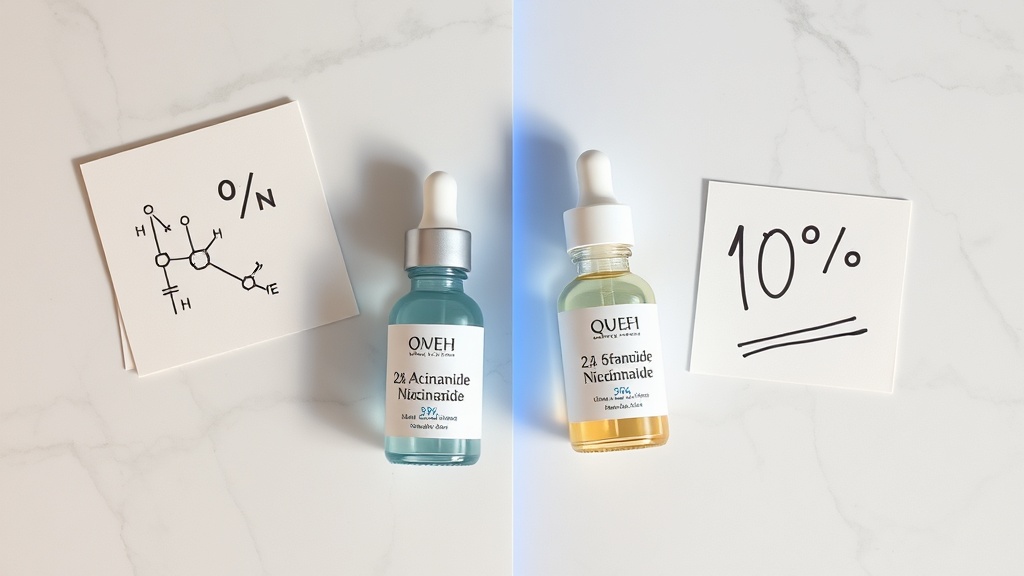
2% vs 10% Niacinamide: What Actually Changes (and What Doesn’t)

If you ask me what ingredient gets overworked, over-sold, and under-scientifically explained, it’s often niacinamide.
Everyone thinks more means better.
Sometimes, it does.
Usually, it means you’re solving the wrong problem.
And that matters because niacinamide is one of the few ingredients where concentration changes the skin feel a lot, but often not as dramatically as people think.
What most people get wrong about niacinamide
When people start shopping for “the best niacinamide,” there are three recurring myths:
- 2% is weak.
- 10% is always stronger.
- 10% is better for every skin type and every concern.
None of those are true.
Niacinamide’s molecular action is broad: barrier support, sebum modulation, barrier signaling, anti-inflammatory effects, and some pigment-related pathways.
You don’t get a whole new mechanism at 10%. You usually just get stronger side effects and often a stronger texture story.
2% is not “starter,” it’s a legitimate therapeutic dose
A PubMed clinical trial on facial sebum production found meaningful sebum reduction with 2% after 4 weeks in one Japanese cohort and reduced casual sebum in a Caucasian split-face cohort after 6 weeks.
That’s enough evidence that 2% is not a weak “entry-level” number.
The take-home is simple:
- If your first goal is a gentler barrier-friendly start, 2% can be very effective.
- If your concern is moderate oil control and texture, 2% is often where many people should start.
So why are people obsessed with 10%?
Because 10% is visible on social posts.
Higher concentration can be useful, but mostly for three reasons:
- You tolerate actives well and want stronger anti-inflammatory punch.
- You already run a minimal routine and want a single multitasker.
- You need formulation depth and can’t tolerate underperforming textures at lower strengths.
For most skin, 10% is not a magic barrier reset.
It’s a stronger ingredient dose in the same bucket.
And sometimes a harsher bucket.
The strongest practical rule I use: concentration is for problem complexity, not ego
If your skin is already irritated, sensitized by retinoid frequency, or recovering from procedures, don’t start at 10%.
You may get:
- Stinging when layering.
- More visible texture shift from irritation than from active benefit.
- Pigment risk in skintones with higher melanin if inflammation increases.
For melanin-rich skin, the bigger danger with higher concentration is not “over-dosage,” it’s inflammatory fallout.
This is why I still call 2–5% a smarter default and only step up when your skin confirms it can handle the next level.
What 10% does better than 2%
If used correctly, 10% may offer stronger support in:
- heavier oil- and congestion-prone mornings,
- stronger texture fatigue when you also want extra antioxidant support in the same formula,
- and situations where you’ve already proven tolerance with lower strengths.
But this benefit is usually incremental, not dramatic.
If you think 10% is a totally different molecule, it’s not.
Evidence snapshot beyond sebum
A melasma clinical trial compared 4% niacinamide with hydroquinone over 8 weeks. Both reduced pigment, and the safety profile of niacinamide was better.
That data point matters because it shows two things at once:
- Niacinamide’s evidence for pigment support is real.
- It’s not only high percentages that drive results.
For practical skincare, this means you should optimize consistency first, then concentration.
Build your niacinamide plan without guessing
Start with a simple decision tree
- If your skin is calm and mostly reactive to environment: start with 2%.
- If you’re acne-prone and oil-heavy but reactive: start at 2–4%, increase only if no irritation after 6 weeks.
- If you already use actives like retinoids, vitamin C, or AHAs: stay at 2% first unless your skin is over a year of steady routine.
- If your priority is texture-only and you already tolerate stronger actives: 5–10% can be considered.
Layering rules that matter more than percentage
- Apply niacinamide on damp skin after hydrating serum layers are in place.
- Don’t combine with harsh exfoliant on the same night when first testing higher concentrations.
- If you’re building an active-heavy routine, move niacinamide to morning or low-stress nights and keep actives separated.
- Patch-test once on each side of the face, and monitor 3 things: stinging, redness, and post-inflammatory spots over 7 days.
3 budget-aware options that won’t break behavior
I’m not here to worship formulas. I’m here to keep your routine sustainable.
- Budget: The Ordinary Niacinamide 10% + Zinc (or a similar low-cost 2–5% option), if you need coverage per dollar and can tolerate texture.
- Mid-range: A clinically consistent 5% to 10% serum with simple supporting ingredients and clean skin-feel.
- Higher end: A premium niacinamide formula where the matrix is calmer on skin and less likely to trigger pilling in long routines.
Budget and texture are practical variables.
If the expensive formula is one you skip because of texture, the concentration advantage disappears immediately.
My opinion, straight up
There is no winner’s bracket here.
For most people, 2% is not beginner-only — it’s smart first-line.
For many people, 10% is the next sensible step only after skin tolerance is proven.
For everyone, the mistake is to skip month one and jump straight to “maximum dose” because “if some is good, more is better.”
The formula that sticks for 28 days is the formula that works.
No amount of active strength can fix a routine that you abandon after day three.
What to use this week
Try this no-risk protocol:
- Days 1–14: 2% niacinamide only.
- Days 15–21: if skin is calm, continue as is.
- Days 22–28: move to 5% or 10% only if sebum and texture are not improving and irritation score is low.
If irritation appears at 2%, you already got your answer.
Don’t chase stronger just to feel “scientific.”
Your skin has limits, and respecting them keeps results boringly reliable.
Medical disclaimer: This is educational, not medical advice. If you have active eczema, rosacea, recent procedures, or pregnancy-related concerns, check with a dermatologist before introducing or increasing active concentrations.
Evidence references: PubMed abstracts on 2% niacinamide and sebum regulation; PubMed data comparing 4% niacinamide with hydroquinone for pigmentation.
— Priya Chakraborty